Office History
From its origins at the US Weather Bureau to the modern university-based offices, North Carolina has a history of climate services dating back more than 130 years, spanning multiple institutions and directors. This page includes a snapshot of this storied past.
The Weather Bureau Era
Beginning in the 1890s, climate services were provided by the US Weather Bureau, which operated hundreds of local offices across the country but typically designated one office per state as the Section Center. In North Carolina, that was always the Raleigh office, which was initially co-located with the state Agriculture Experiment Station, and later housed at the Raleigh Municipal Airport, State College (which became NC State University), and Raleigh-Durham International Airport.
The director of the Raleigh Weather Bureau office had a role similar to today’s state climatologists, including collecting and sharing weather observations, overseeing research about statewide climate patterns and trends, and providing insights and interviews to the media. Thus, these Section Directors can be considered our state’s first set of leading climate experts.
H. B. Battle (c. 1891 to c. 1896)
Battle was the first director of the state Agricultural Experiment Station in Raleigh, which oversaw the State Weather Service. As a nod to those agricultural roots, Battle also held the title of “State Chemist”.
Charles F. von Herrmann (c. 1897 to Aug. 1905)
Initially a meteorologist at the state Agricultural Experiment Station, von Herrmann became director of the Climate and Crop Service of the Weather Bureau in North Carolina, compiling observation records and monthly summaries across the South Atlantic region.
Alfred H. Thiessen (Aug. 1905 to c. 1908)
The first section director of the renamed Climatological Service of the Weather Bureau in North Carolina, Thiessen’s work included requesting and receiving meteorological reports, such as those collected in western North Carolina by forestry pioneer Carl Alwin Schenck.
Lee A. Denson (c. 1909 to c. 1938)
The longest-tenured weather or climate service director in our state’s history, Denson expanded the state’s observation network beyond Raleigh to measure statewide weather and extremes, including high winds during the September 1933 Outer Banks hurricane.
Herbert E. Kichline (c. 1939 to Jun. 1944)
Kichline spent nearly 40 years working for the Weather Bureau, including as an associate meteorologist under Denson. One of the final weather events he covered was the September 1945 Homestead hurricane, which caused flooding in eastern North Carolina.

Clarence E. Lamoureux (Jan. 1945 to 1948)
Lamoureux took observations to heart, personally measuring snowfall in Raleigh and providing weather data to aid in a study of pine pollen dispersion. He left Raleigh in 1948 to take a job with the Weather Bureau in Des Moines.
Garrett DeMots (Apr. 1948 to Jan. 1951)
A native of Iowa and a graduate of the University of Chicago, DeMots brought his experience with extended-range forecasting to North Carolina. In 1951, he left to take a position in Washington, DC, in President Truman’s Department of Commerce.
Charles B. Carney (Feb. 1951 to 1960)
Apparently the first to use the title “State Climatologist” in North Carolina, Carney was a prolific writer, authoring monthly climate summaries for the Carolinas and an acclaimed hurricane history. He was also honored for his leadership during hurricanes Connie and Diane in 1955.
Albert V. Hardy (Jun. 1960 to 1972)
Our final state climatologist in the US Weather Bureau era, Hardy embodied the mission of past and present climate services, from conducting observations and research of low temperature probabilities to providing the media with perspectives about drought.

The Modern State Climate Office
The federal State Climatologist program under the US Weather Bureau was terminated on April 16, 1973, leaving it up to individual states to develop their own climatology programs at universities or state agencies to provide those same climate services. In North Carolina, the Office of the State Climatologist was formally established by a joint agreement between the President of the University of North Carolina system and the Director of NOAA’s National Climatic Data Center. The office was first housed at UNC-Chapel Hill in 1976, then transferred to NC State University in 1980.
Today, North Carolina’s State Climate Office is one of the most active offices in the nation, and was acknowledged by the American Association of State Climatologists as one of the first officially recognized State Climate Offices. The office is actively pursuing a wide range of research, monitoring, and educational activities to support North Carolinians through improving our understanding of the complex interactions between North Carolina’s weather, climate, the environment, and people.
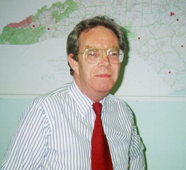
Dr. Peter Robinson (1976 – 1980)
In 1976, the first North Carolina State Climate Office was opened in the Department of Geography at UNC-Chapel Hill with Dr. Peter Robinson as the State Climatologist. In those days, most data requests were in the form of telephone calls or letters, with the requested data being photocopied and mailed, or simply dictated over the phone. Reflecting the old federal program’s close connection with agriculture, many of these requests came from agribusiness. From the start, there was close cooperation between universities, with the State Climatologist sitting on various extension and research committees at NC State.
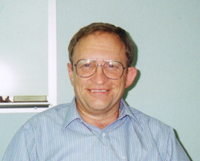
Dr. Jerry Davis (1980 – 1996)
In 1980, through a Memorandum of Agreement, the North Carolina State Climate Office was moved to the Department of Marine, Earth, and Atmospheric Sciences at North Carolina State University. Dr. Jerry Davis, Professor of Atmospheric Sciences, was appointed as State Climatologist and served in this role for the next 16 years. Over this period, the office’s research addressed issues such as precipitation variability and the definition of local climates.
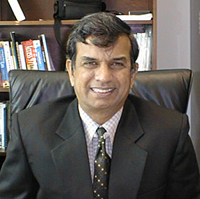
Dr. Sethu Raman (1996 – Jul. 2006)
In 1996, Dr. Sethu Raman, Professor of Atmospheric and Marine Sciences, was appointed State Climatologist. That year, the office was moved to NC State University’s Centennial Campus and co-located with the National Weather Service office in Raleigh. Dr. Raman expanded the presence of the office, expanding its staff, taking responsibility for the Agricultural Weather Network (now ECONet), and seeing the office designated as a Public Service Center by the UNC Board of Governors in 1998. Dr. Raman retired in July 2016.
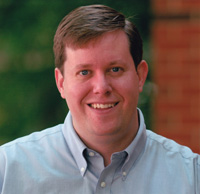
Dr. Ryan Boyles (Jul. 2006 – Jul, 29, 2016)
Dr. Ryan Boyles was named as State Climatologist and Director of the State Climate Office in 2006. Dr. Boyles began working with the office in 1997 and was one of the first graduate students to work with Dr. Raman. Dr. Boyles continued the successful program started under Dr. Raman, with an emphasis on the office’s public service mission for climate science extension, research, and education. In 2016, Ryan left the office and joined the USGS Climate Adaptation Science Centers.
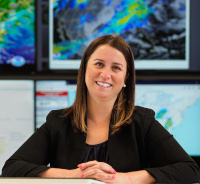
Dr. Kathie Dello (Jul. 8, 2019 – Aug. 30, 2025)
In 2019, Dr. Kathie Dello was hired, becoming the first female Director and State Climatologist in North Carolina. Building on her work at Oregon State University doing climate impact assessments and resilience planning, Dr. Dello helped author North Carolina’s first Climate Science Report and the Southeast chapter of the Fifth National Climate Assessment, while also expanding the office’s project portfolio and growing our visibility at the university, state, and national levels. In 2026, Kathie left to join the NC Department of Environmental Quality as the Assistant Secretary for Resilience.

Dr. Jared Bowden (May 1, 2026 – present)
After joining our office as the Associate Director in 2024, Dr. Jared Bowden was hired as the new Director and State Climatologist in 2026. A native of North Carolina, Dr. Bowden is a graduate of NC State University with more than 20 years of experience with climate research in the state, including with future precipitation projections and their impacts on engineering design. Dr. Bowden is a former National Research Council postdoctoral researcher who worked closely with scientists at the US Environmental Protection Agency.