Thresholds for Extreme Heat
Extreme heat and extreme heat events occur when temperatures or heat indices surpass specific thresholds. A heat threshold refers to a specific temperature above which environmental conditions are considered extreme or hazardous. These thresholds can be based on air temperatures or other heat stress indicators such as the heat index or Wet Bulb Globe Temperature. Heat thresholds help us understand not just how hot it is, but how the heat might affect us, making it clear when we are facing extreme or hazardous conditions. At temperatures higher than established heat thresholds, negative health impacts begin to occur, and days or periods with these temperatures are considered extreme heat events.
The temperature at which humans begin to experience negative health impacts is different for everyone. That temperature can vary by what temperatures your body is used to, age, pre-existing health conditions, medications taken, and more. Scientists and state and federal agencies typically identify heat thresholds for geographic areas with similar climates, ensuring guidelines are tailored to local conditions and residents’ needs.
Scientists in North Carolina developed these thresholds based on daily maximum heat index, heat-related emergency department visits, and mortality records in North Carolina over the period 2007-2022. Specifically, researchers calculated heat index thresholds for the early heat season (May 1 – June 21), mid-season (June 22 – August 10), and late season (August 11 – September 30) by correlating the maximum heat index of any given day with the corresponding number of heat-related emergency department visits and deaths for that day. They organized this analysis into eight groups of counties. Each grouping includes North Carolina counties with similar climate patterns.
North Carolina’s heat thresholds were developed through a partnership between the State Climate Office of North Carolina, Duke University’s Nicholas Institute for Energy, Environment and Sustainability and the North Carolina Department of Health and Human Services. Partners will update the thresholds on the website as more data become available, ensuring local governments have the most up-to-date thresholds to safeguard their communities against extreme heat. The most recent update took place in Spring 2025. Thresholds are not expected to change more often than every two to three years. Sign up for the State Climate Office Blog or the State Resilience Office’s Spotlight on Resilience monthly e-newsletter to receive a notification when heat thresholds are updated. Sign up for Heat Health Alerts from NCDHHS to receive an alert if the heat index is expected to reach these thresholds for your county.
Refer to the maps and tables below to identify the recommended heat index threshold for your locale.
NC Heat Index Thresholds – Maps
NC Heat Index Thresholds – Full Season Map

NC Heat Index Thresholds – Early Season Map

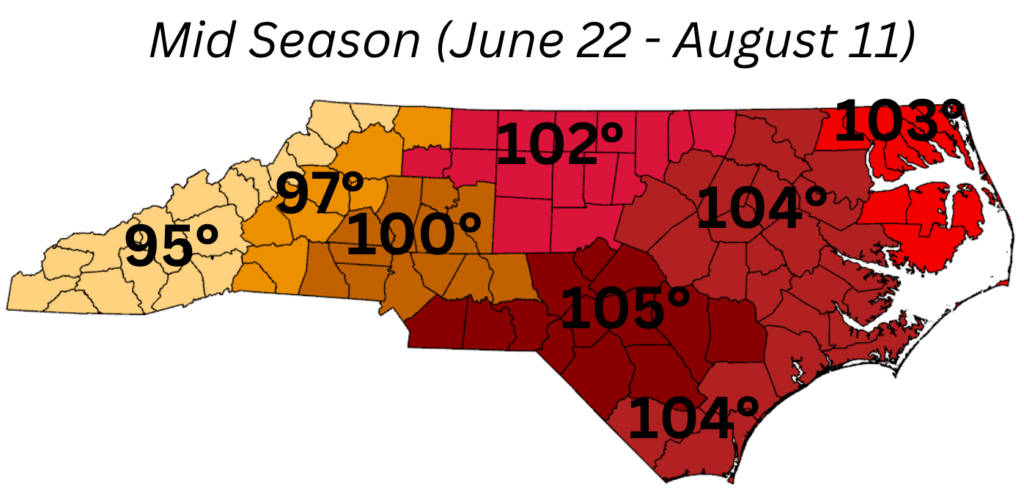
NC Heat Index Thresholds – Mid Season Map
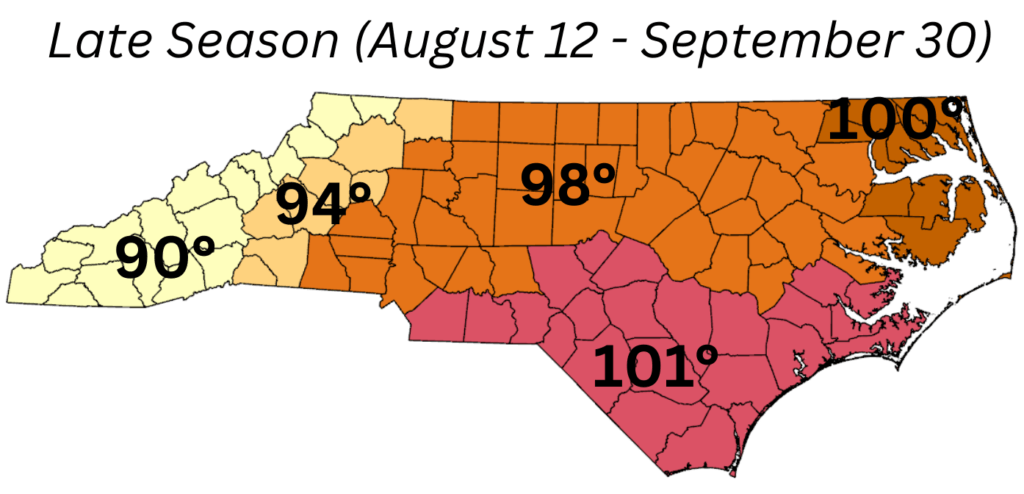
NC Heat Index Thresholds – Late Season Map
NC Heat Index Thresholds – Table
Region Early Season
(May 1 – Jun 21)Mid Season
(Jun 22 – Aug 10)Late Season
(Aug 11 – Sep 30)1. Southeast 95ºF 103ºF 100ºF 2. North Central 94ºF 102ºF 98ºF 3. Northeast 95ºF 104ºF 101ºF 4. South Central 95ºF 100ºF 98ºF 5. North Coastal Plain 98ºF 104ºF 98ºF 6. Foothills 92ºF 97ºF 94ºF 7. Sandhills 99ºF 105ºF 101ºF 8. Mountains 85ºF 94ºF 90ºF
NC Heat Index Thresholds – Region County List

Region 1: Southeast
- Brunswick
- Carteret
- Columbus
- Craven
- Jones
- New Hanover
- Onslow
- Pamlico
- Pender
Region 2: North Central
- Alamance
- Caswell
- Chatham
- Durham
- Forsyth
- Granville
- Guilford
- Orange
- Person
- Randolph
- Rockingham
- Stokes
- Vance
- Warren
- Yadkin
Region 3: Northeast
- Camden
- Chowan
- Currituck
- Dare
- Gates
- Hertford
- Hyde
- Pasquotank
- Perquimans
- Tyrrell
- Washington
Region 4: South Central
- Cabarrus
- Catawba
- Cleveland
- Davidson
- Davie
- Gaston
- Iredell
- Lincoln
- Mecklenburg
- Montgomery
- Rowan
- Stanly
Region 5: North Central Plain
- Beaufort
- Bertie
- Edgecombe
- Franklin
- Greene
- Halifax
- Johnston
- Lenoir
- Martin
- Nash
- Northampton
- Pitt
- Wake
- Wayne
- Wilson
Region 6: Foothills
- Alexander
- Burke
- Caldwell
- McDowell
- Polk
- Rutherford
- Surry
- Wilkes
Region 7: Sandhills
- Anson
- Bladen
- Cumberland
- Duplin
- Harnett
- Hoke
- Lee
- Moore
- Richmond
- Robeson
- Sampson
- Scotland
- Union
Region 8: Mountains
- Alleghany
- Ashe
- Avery
- Buncombe
- Cherokee
- Clay
- Graham
- Haywood
- Henderson
- Jackson
- Macon
- Madison
- Mitchell
- Swain
- Transylvania
- Watauga
- Yancey